3 October 2026 · 5 min
The Two Worlds of Wine
I was out to dinner a while back and watched someone pick up the wine list, skip the whites entirely and start reading at the reds. Not a decision – a reflex. It’s a common one.
I drink both, happily, and this isn’t a case for one over the other. But if you asked me which of the two has more going on – more moving parts, more detail to get lost in – I’d say whites, and I wouldn’t need long to think about it.
Reds have the prestige, and they’ve earned a lot of it. The collectible bottles, the vintages people argue about for decades, the terroir mythology, the cellar – that’s mostly red territory. If wine is a status game or an investment, reds win and it isn’t close.
But prestige and range are different things. Reds vary along a short list of axes: tannins, oak, fruit. The gap between a Pinot Noir, a Nebbiolo and a Cabernet is real and worth caring about, but it comes down to those three dials, and everything routes back through tannin.
Whites have more dials, and the dials turn independently. Acidity, sweetness, weight and aroma each do their own thing. You can run from bone-dry and mineral – a Chablis, or an Assyrtiko that tastes of salt and stone – through the lush, oaked weight of a white Burgundy, out to an off-dry Riesling or a Gewürztraminer that’s all lychee and rosewater, and then keep going into skin-contact “orange” wine, which sits on its skins like a red and comes out with actual tannin and grip. That’s an enormous spread, and at no point does tannin have to be the thing doing the talking.
I wanted to be sure this wasn’t just my palate talking, so I checked. A while back I built a wine app, Ampelos, with a taxonomy of a hundred-odd grape varieties, each scored for body, tannin, acidity, sweetness and aromatic intensity, with its flavour descriptors and the aroma compounds behind them. The split is almost even – 57 whites, 52 reds. The shape of the data is the interesting bit. In the reds, body and tannin move together so closely they may as well be one dial, sweetness is pinned at dry, and aromatic intensity sits at “medium” for most of them. The variation is nearly all structure. In the whites, tannin is the thing that’s pinned and everything else is loose: acidity and aroma spread right across their range, sweetness runs from bone-dry to dessert, and apart from the sweet ones tending to be the perfumed ones, none of it tracks anything else. Count the distinct combinations of those three and the whites produce two and a half times as many as the reds, from roughly the same number of grapes.
Here’s what that looks like for a single white. This is Heritage Estate’s Fumé Marsanne from the Granite Belt – a barrel-fermented Marsanne – run through the app, which separates what the grape brings from what the place and the winemaking added:
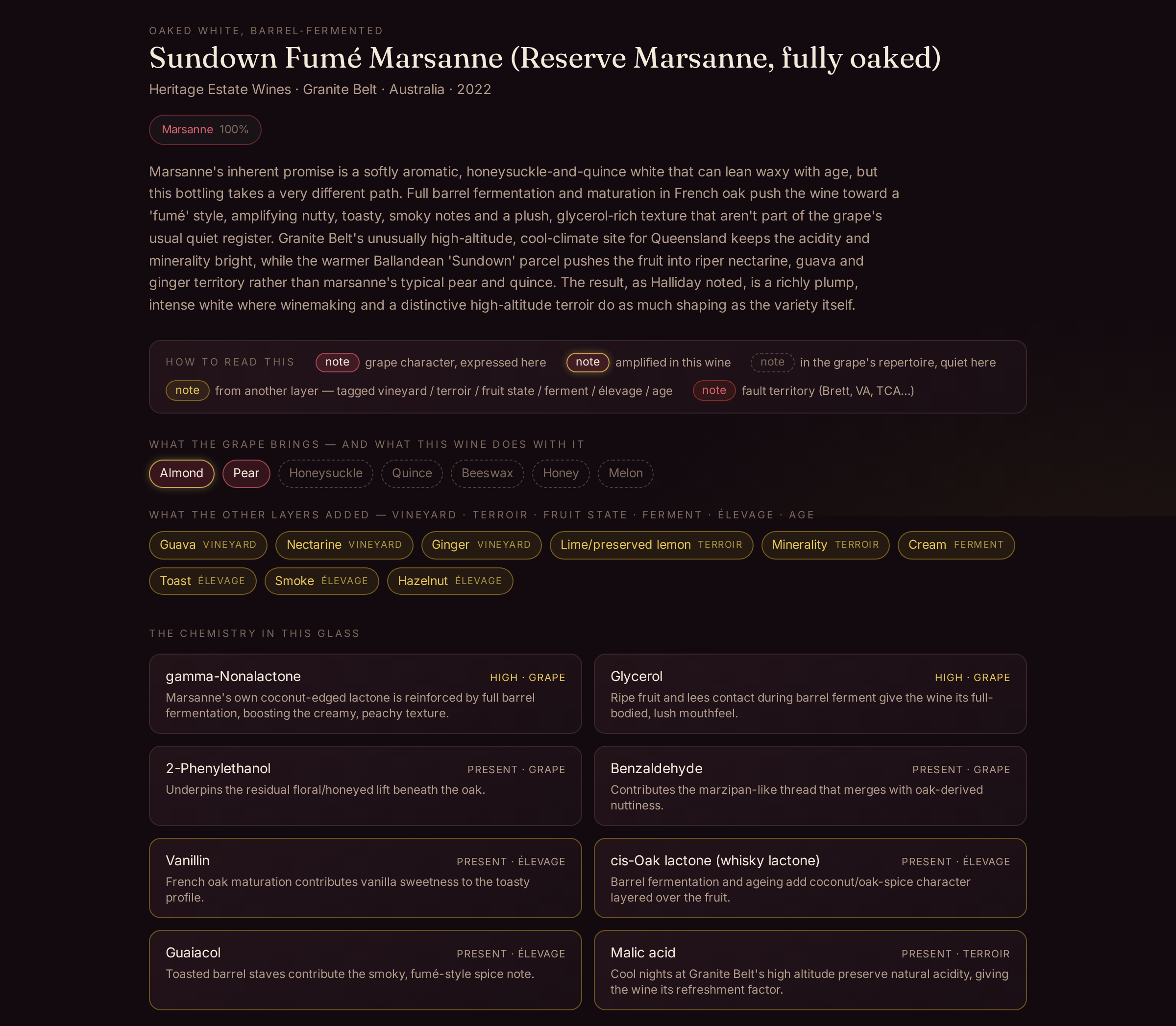
You can also see the winemaking. Virtually every red goes through malolactic conversion; in a white it’s a choice, and you can taste which way it went. Stirring the lees, oxidative handling versus reductive – in a white these show up as texture and smell you can point at: butter, brioche, bruised apple, struck match. That same taxonomy has a whole flavour category for fermentation and lees character, and not a single red grape touches it. In a red the same techniques get folded into “how much oak, how much tannin, how ripe,” which flattens the differences. Both get to an answer. A white shows its working on the way there, and that’s where the riches are. A red hands you the answer with the working rubbed out.
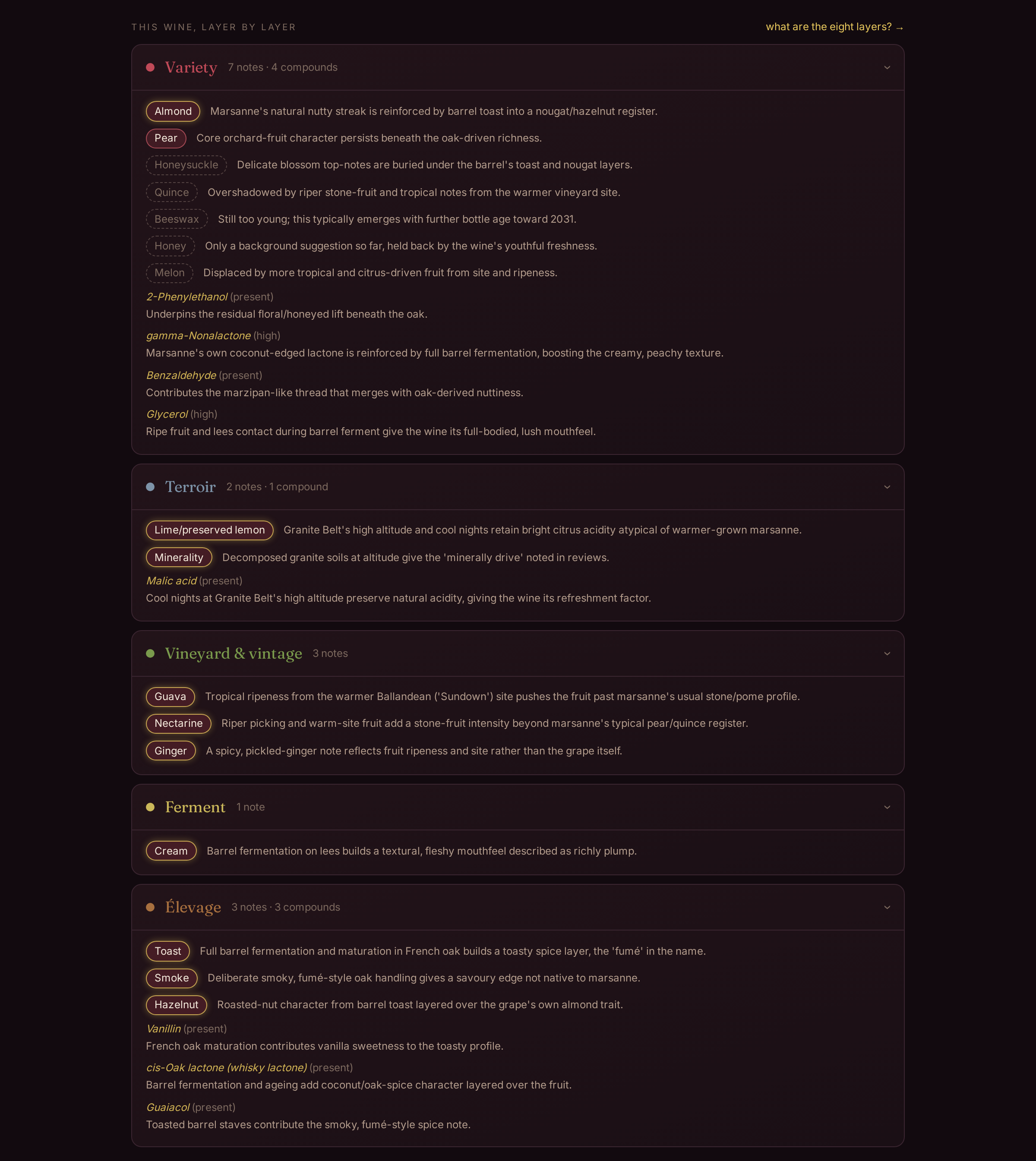
The same Marsanne, layer by layer. Seven of the grape’s own notes, then terroir, vineyard, ferment and élevage each adding their own – and the honeysuckle and quince the grape would normally offer, sitting quiet under the oak. That’s the working:
Reds do have territory of their own – pepper and spice, earth, the long slide into leather and truffle with age – and I’m not pretending otherwise. It’s just a smaller territory than the reputation suggests.
If you want the whole argument in one glass, find a Shiraz with a few percent of Viognier in it – two to five, co-fermented, the way they’ve always done it in Côte-Rôtie and the way Clonakilla has done it in Canberra for decades. It’s a trivial amount of white grape. The wine is not trivially different: the perfume lifts, there’s apricot and florals over the dark fruit, the texture goes silky, and it is plainly not a straight Shiraz. Five percent of white, and the red is a different wine. That’s how much is packed into the white side.
None of this is theoretical, either. The most interesting experimental work in Australian boutique wine right now is on the white side – skin-contact Semillon out of the Barossa, wild-ferment Riesling, aromatic blends nobody’s bothering to attempt with reds. The energy is in the whites.
So keep buying the reds. Argue about the vintages, lay them down, pay too much for the good ones – all of that is genuinely fun and I do it too. Just don’t skip past the whites on the way. And don’t reach for the one you already know, either – the New Zealand Sauvignon Blanc is the same reflex in white. Go to a decent wine shop and ask for something off the usual list: a Roussanne or a Marsanne, a Viognier, a Chenin Blanc, an Alsace Gewürztraminer, a Fiano, an Assyrtiko, a Grüner Veltliner, a Hunter Semillon with ten years on it. That’s the other world, and it’s the bigger one.